Metacognative learning strategies give you the tools to really learn the material in your courses not just get enough information to maybe get an A on the test. Metacognition is thinking about your thinking. Analyzing if your study methods are actually helping you reach your goals. How well you do in your classes is a direct reflection of your behavior. If what you are doing isn't getting you the grades you want, you must try something different! Dr. Saundra McGuire has created several steps that help students turn their grade around. She has had many students go from failing tests to getting A's after applying metacognition. In this video she talks about what metacognition is and how it can help students.
Watch this video on the Study Cycle to learn about the Study Cycle that Dr. McGuire and her staff at LSU put together. If you commit to these steps, you will learn much more efficiently and your learning will be more complete.

by Kristie Bradford, Professor of Geology
Sunday, October 9, 2016

Bowen's Reaction Series - Relationship between ignous rocks, minerals, and silica content
Bowen's Reaction Series
In the early 1900's, N. L. Bowen and others at the Geophysical Laboratories in Washington D.C. began experimental studies into the order of crystallization of the common silicate minerals from a magma. The idealized progression which they determined is still accepted as the general model for
the evolution of magmas during the cooling process.
The Principles that Bowen realized are as follows:
To summarize: Bowen determined that specific minerals form at specific temperatures as a magma cools. At the higher temperatures associated with mafic and intermediate magmas, the general progression can be separated into two branches (see below). The continuous branch describes the evolution of the plagioclase feldspars as they evolve from being calcium-rich to more sodium-rich. Plagioclase feldspar crystals have a core that is calcium-rich and a rim that is sodium-rich. The average composition of the calcium and sodium content in plagioclase feldspars will approximate the calcium and sodium composition of the magma.
In the early 1900's, N. L. Bowen and others at the Geophysical Laboratories in Washington D.C. began experimental studies into the order of crystallization of the common silicate minerals from a magma. The idealized progression which they determined is still accepted as the general model for
the evolution of magmas during the cooling process.
The Principles that Bowen realized are as follows:
- As a melt (the liquid portion of the magma) cools minerals crystallize that are in thermodynamic equilibrium with the melt (dissolution equals crystallization; if no equilibrium exists either crystallization will dominate [supersaturation], or dissolution will dominate [undersaturated]).
- As the melt keeps cooling and minerals keep crystallizing, the melt will change its composition.
- The earlier formed crystals will not be in equilibrium with this melt any more and will be dissolved again to form new minerals. In other words: these crystals react with the melt to form new crystals, therefore the name, reaction series.
- The common minerals of igneous rocks can be arranged into two series, a continuous reaction series of the feldspars, and a discontinuous reaction series of the ferromagnesian minerals (olivine, pyroxene, hornblende, biotite)
- This reaction series implies that from a single "parental magma" all the various kinds of igneous rocks can be derived by Magmatic Differentiation (see below)
To summarize: Bowen determined that specific minerals form at specific temperatures as a magma cools. At the higher temperatures associated with mafic and intermediate magmas, the general progression can be separated into two branches (see below). The continuous branch describes the evolution of the plagioclase feldspars as they evolve from being calcium-rich to more sodium-rich. Plagioclase feldspar crystals have a core that is calcium-rich and a rim that is sodium-rich. The average composition of the calcium and sodium content in plagioclase feldspars will approximate the calcium and sodium composition of the magma.
Igneous Rocks
Igneous rocks are rocks formed through the crystallization of magma either on the surface as volcanic (extrustive) rocks or deep underground as plutonic (intrusive) rocks. Remembering that at one time early in our Earth's history, the Earth was molten. When the Earth cooled, the minerals crystallized into igneous rocks. Therefore, the rock cycle on Earth, begins with magma.

Rocks are classified as igneous, metamorphic, and sedimentary based on origin. Classification schemes are designed to answer a specific question or to organize the objects of the classification scheme in groups for easier identification and understanding. Sometimes classification allows us to see patterns in data which can then lead to interpretations. Oftentimes it is just a system of organization to handle quantities of data that are two large to be examined individually. Within each rock type are further classification schemes to better understand how the rocks were formed.

Rocks are classified as igneous, metamorphic, and sedimentary based on origin. Classification schemes are designed to answer a specific question or to organize the objects of the classification scheme in groups for easier identification and understanding. Sometimes classification allows us to see patterns in data which can then lead to interpretations. Oftentimes it is just a system of organization to handle quantities of data that are two large to be examined individually. Within each rock type are further classification schemes to better understand how the rocks were formed.
Wednesday, September 28, 2016
How to plot 2 scattered plots on the same graph using Excel 2007
Below is a video with instructions on how to create a scatter plot on Excel (it works the same way for Excel 2010 and 2013) with more than one set of data on the graph. These instructions are perfect for making your graphs for the Cemetery lab write up. It is best to put data that you plan to compare on the same set of axes. It makes comparison so much easier.
You should also add a best fit line by choosing linear from the trend line options instead of polynomial as the man did in this video. Be sure to check the intercept box and have the intercept be 0.0 so that the trend line will go through the origin.
You should also add a best fit line by choosing linear from the trend line options instead of polynomial as the man did in this video. Be sure to check the intercept box and have the intercept be 0.0 so that the trend line will go through the origin.
Thursday, September 22, 2016
Sunday, August 28, 2016
Cognitive Dissonance and the Nature of Science
Cognitive Dissonance Theory was proposed in 1957 by Leon Festinger. His theory states that cognitive dissonance is the mental stress or discomfort experienced by an individual who holds two or more contradictory beliefs, ideas or values at the same time; or, is confronted by new information that conflicts with existing believe, ideas or values. This mental stress or discomfort can be as strong as thirst or hunger. When we experience hunger or thirst, we look to relieve that stress by getting something to eat or drink. When a person experiences cognitive dissonance, they are equally as driven to reduce that dissonance and reach consonance. In addition to trying to reduce dissonance, a person may actively avoid situations and information that would likely increase dissonance.
In science, cognitive dissonance can be a strong driver to move science forward or it can be an anchor holding science back depending on how consonance is achieved. The history of science is littered with stories of both moving forward and holding back. Whether new information will move science forward or whether it will hold it back is up to the scientist who examine that information.
For example, Lord Kelvin, the famous physicist who formulated the first and second laws of thermodynamics, attempted to calculate the age of the earth using using thermodynamics, looking at heat transfer within the earth itself and from the sun to the earth. He calculated the age of the earth to be between 20 million years and 100 million years using mathematical models that he derived. Therefore, his calculations were only as good as his models which, in hindsight, turned out to not be very good. Geologists and biologists knew that the age of the earth HAD to be much older. Their observations of processes and changes indicated that a VAST amount of time had passed to create many of the creatures and landscapes they observed. As new information about heat sources within the earth came to light, Kelvin stubbornly refused to acknowledge this new information. His understanding of mathematics and thermodynamics shaped how he saw the world which in turn clouded his judgement. Check out these articles by T. H. Heaton and M. Livio for more information on Lord Kelvin's mistake.
A recent example that I heard about on NPR on my way to class one morning is a perfect example of cognitive dissonance moving science forward. Have a listen:
Here is a video by Richard Norris of the research he and his cousin, James Norris, conducted. Their paper is publish in PLOS One.
Here is a whiteboard explanation of how the rock are moving:
Paula Messina, featured in the NPR recording, had written her PhD thesis on the movement of these rocks. Her data suggested that the most likely explanation for the rocks' movement was freak wind storms that pushed the rocks on a thin film of water creating the grooves in the soft sediment. The Norris' data flew directly in the face of her thesis! At first, she admits, she couldn't believe what they were saying, she was in a state of cognitive dissonance. She needed to see for herself that large, wind-blown sheets of ice were the driving force behind the moving rocks as shown in this cellphone video captured by John Chadbourne. The rocks are moving to the left:
In the end, Dr. Messina reached consonance by accepting the new information and abandoning her old explanation. Science moved forward! Dr. Messina and other researchers working on the rocks of Racetrack Playa could have become increasingly dogmatic as new information came to light, strongly sticking to their explanation as a means to reach consonance. If that happened, those researchers would have either been marginalized or they may have put the breaks on the understanding of the rocks at Racetrack Playa.
In science, cognitive dissonance can be a strong driver to move science forward or it can be an anchor holding science back depending on how consonance is achieved. The history of science is littered with stories of both moving forward and holding back. Whether new information will move science forward or whether it will hold it back is up to the scientist who examine that information.
For example, Lord Kelvin, the famous physicist who formulated the first and second laws of thermodynamics, attempted to calculate the age of the earth using using thermodynamics, looking at heat transfer within the earth itself and from the sun to the earth. He calculated the age of the earth to be between 20 million years and 100 million years using mathematical models that he derived. Therefore, his calculations were only as good as his models which, in hindsight, turned out to not be very good. Geologists and biologists knew that the age of the earth HAD to be much older. Their observations of processes and changes indicated that a VAST amount of time had passed to create many of the creatures and landscapes they observed. As new information about heat sources within the earth came to light, Kelvin stubbornly refused to acknowledge this new information. His understanding of mathematics and thermodynamics shaped how he saw the world which in turn clouded his judgement. Check out these articles by T. H. Heaton and M. Livio for more information on Lord Kelvin's mistake.
A recent example that I heard about on NPR on my way to class one morning is a perfect example of cognitive dissonance moving science forward. Have a listen:
Here is a video by Richard Norris of the research he and his cousin, James Norris, conducted. Their paper is publish in PLOS One.
Here is a whiteboard explanation of how the rock are moving:
Paula Messina, featured in the NPR recording, had written her PhD thesis on the movement of these rocks. Her data suggested that the most likely explanation for the rocks' movement was freak wind storms that pushed the rocks on a thin film of water creating the grooves in the soft sediment. The Norris' data flew directly in the face of her thesis! At first, she admits, she couldn't believe what they were saying, she was in a state of cognitive dissonance. She needed to see for herself that large, wind-blown sheets of ice were the driving force behind the moving rocks as shown in this cellphone video captured by John Chadbourne. The rocks are moving to the left:
In the end, Dr. Messina reached consonance by accepting the new information and abandoning her old explanation. Science moved forward! Dr. Messina and other researchers working on the rocks of Racetrack Playa could have become increasingly dogmatic as new information came to light, strongly sticking to their explanation as a means to reach consonance. If that happened, those researchers would have either been marginalized or they may have put the breaks on the understanding of the rocks at Racetrack Playa.
Wednesday, March 30, 2016
Metamorphic Rocks
The best way to study the metamorphic rocks is to separate them into two groups:
Non-foliated rocks do not have a layering present that was developed during metamorphism either because there is no elongate or platy mineral present as is the case with quartzite and marble or the rock was metamorphosed under confining stress rather than differential stress. Key clues to identify the non-foliated rocks:
- Follated Rocks - slate, phyllite, schist, and gneiss
- Non-folliated Rocks - marble, quartzite, hornfels, and coal
- slate: very fine-grained; dull appearance; can be red, black, gray, or green; displays good to excellent rock cleavage; foliation type: slatey cleavage

- phyllite: fine-grained; greasy/glossy sheen; can be black, gray, or green typically; can display good to excellent rock cleavage; the layers are often crinkled into tiny folds; there is no specific foliation type so, in this class, we will call it phyllite-type.
 |
| Photo credit: James St. John |
- schist: medium- to coarse-grained; sparkly or glittery; foliation type: schistosity May be mica-rich or may be amphibole-rich (hornblende-rich).
- gneiss: medium- to coarse-grained; dark and light banding; foliation type: gneissic banding.
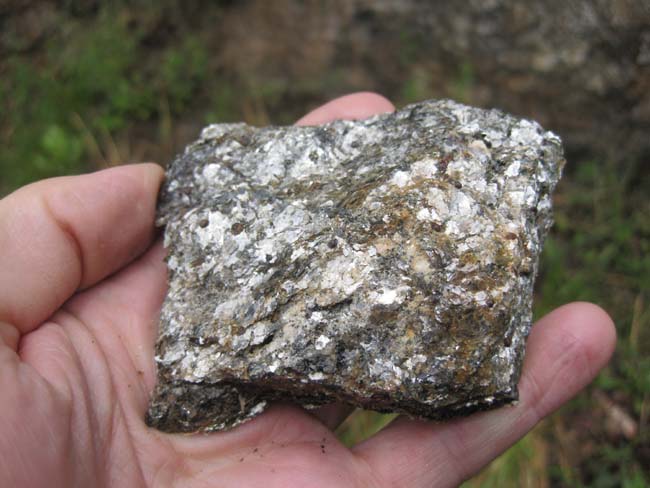 |
| Garnet mica schist |
 |
| Photo Credit: James St. John |
 |
| Beginning with a shale parent rock, this image shows the development of foliation in rocks metamorphosed under regional metamorphism. This continuum is called prograde metamorphism. |
Non-foliated rocks do not have a layering present that was developed during metamorphism either because there is no elongate or platy mineral present as is the case with quartzite and marble or the rock was metamorphosed under confining stress rather than differential stress. Key clues to identify the non-foliated rocks:
- marble: fine- to coarse-grained; white to pink; no layering present; crystals are usually visible and the cleavage planes usually reflect a lot of light giving the rock a glittery luster; hardness is less that a steel nail hardness < 5.5); often reacts with acid.

- quartzite: fine- to coarse-grained; white to pink; no layering present; crystals are not usually visible; conchoidal fracture is sometimes observed on the fracture planes; hardness is greater than a steel nail (hardness > 5.5)

- hornfels: fine-grained, dark rock with no layering; hardness > 5.5
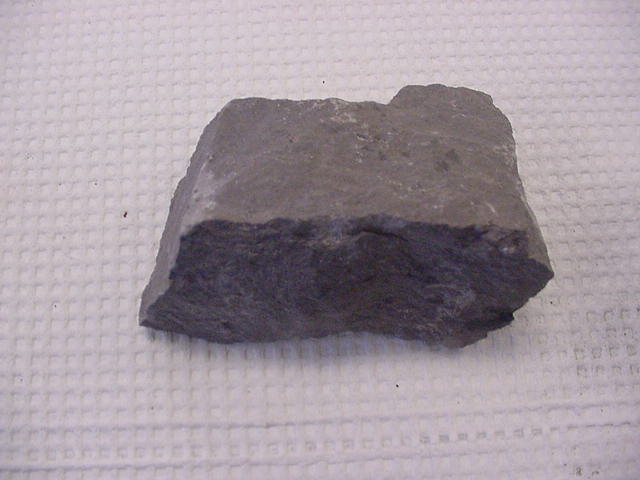
- coal: black "rock" with no grains present; conchoidal fracture is common; "rock" has a low density

Subscribe to:
Posts (Atom)